Flavours to expect
Decaf coffees can be chocolatey, nutty, fruity or floral. The coffee and roast matter as well as the decaffeination method.
Coffee Process
Browse decaffeinated specialty coffee beans from independent roasters, including current prices, origins and tasting notes. There are currently 41 matching coffees in RoastSearch.
A few tips
Use price per 100g to compare different bag sizes. Tasting notes are the roaster’s descriptions, not a guarantee. Check prices and stock on the roaster’s site before buying.
Decaf coffees can be chocolatey, nutty, fruity or floral. The coffee and roast matter as well as the decaffeination method.
Choose flavours and a roast level you would enjoy in any coffee. If caffeine content matters to you, check the roaster’s claims rather than assuming decaf means caffeine-free.
Decaf may need a different grind from your usual coffee. Keep the dose and water amount steady while you adjust, and taste each brew before changing anything else.
Compare brew recommendations, tasting notes and decaffeination methods such as EA, sugarcane or Swiss Water.
Sorted with featured coffees first.
Showing 24 of 41 coffees

A flavorful single origin decaf with smooth maple syrup, green grape, and dark chocolate notes.

Mustefa Abakeno is a smallholder farmer from Jimma in western Ethiopia. His farm has now grown to 18 hectares and is located at 2,040 masl. Mustefa invested in processing equipment early on and established the Beshasha wet mill, enabling him to process and export his own lots and engage directly with buyers. The wet mill also processes coffee from neighbouring smallholders who partner with Beshasha. Mustefa’s relationship with Falcon began in 2021, when Falcon’s agronomy team began investing in the support and training of the neighbouring smallholders Mustefa works with. This included installing shade netting to protect coffee at the hottest parts of the day, as well as increased monitoring to ensure uniform moisture levels during drying. Mustefa also maintains a small field laboratory equipped with a high-specification moisture reader. This allows Mustefa and the Falcon team to take precise measurements of each lot coming through the washing station, enabling individual lots to be critically assessed and categorised according to quality. In 2022, Mustefa invested in four additional purchasing sites, allowing him to extend his outreach to neighbouring smallholders. Coffee from these partner farmers is brought to either Beshasha or its sister wet mill, Kabira, for processing. Through this growing network, Mustefa and the Falcon team are able to continue investing in the local coffee-growing communities, helping to improve both coffee quality and productivity while creating greater opportunities for smallholder farmers.

A blend of Brazilian, Ethiopian and Colombian coffees from Elisabete Martins, Mensur Aba Hika and smallholders in Huila.

A sugarcane-style Colombian decaf from La Plata, made from Caturra, Castillo and Colombia varieties. Dark chocolate, caramel and orange rind notes keep it full-flavoured and espresso-friendly.

A Colombian decaf produced by Condor in the San Agustin area, offering brown sugar sweetness, soft citrus acidity, and a medium body.

Our latest decaf coffee is from Chiapas in Mexico and uses the Mountain Water decaffeination method at the Descamex facility in Córdoba, Veracruz. The water used in this process comes from the Pico de Orizaba, the tallest volcano in Mexico located in Veracruz. This water is used to extract caffeine from the green coffee beans under controlled conditions of flow, temperature, pressure and vacuum in combination with a green coffee concentrate and a sophisticated filtration system (much like the Swiss Water decaffeination method) in combination with special filters. Mountain Water Decaf Quetzal originates from 24 communities located across the VI Frailesca region and the Sierra Mariscal, traversed by the Sierra Madre de Chiapas, Mexico. This coffee is influenced by the favourable microclimates of the El Triunfo Biosphere Reserve, which benefits local biodiversity and the economy. The coffee farms, situated between 1,200 and 1,800 masl, are developed in polycultures that offer significant environmental, social, and economic benefits.

An EA sugarcane decaf from farmers in Minas Gerais, Brazil, built around Catuai and Mundo Novo varieties with nougat, plum, and pecan notes.

This coffee is grown in the Huila region which is located in southwestern Colombia, nestled in-between the Central and Eastern ranges of the Andes. The variation in elevation results in Huila being one of the country's most unique and complex regions of coffee production. Its terroir, climate, and harvest cycles all contribute to the quality of coffee produced here. This coffee is washed and then subsequently decaffeinated. At present, there is no such thing as a genetically decaffeinated coffee, which means that decaf coffee needs to be created by physically removing the caffeine from green coffee beans. Most of today’s decaf processing methods are sophisticated and thorough and can remove 99 percent of the caffeine naturally present in coffee. Coffees of any process (washed, natural, honey, etc) can also be processed for decaffeination. The decaffeination itself takes place after the coffee has been harvested, processed, and had its parchment layer removed. Most of the time, coffees need to be sent to specific facilities to be decaffeinated, rather than having the caffeine removed at the mill level. There are a variety of decaffeination methods, this coffee is processed using Ethyl Acetate. This naturally occurring ester (present in bananas as well as a by-product of fermented sugars) can be isolated and used as a solvent to bond with and remove caffeine from green coffee. First, the coffee is sorted and steamed for 30 minutes under low pressure in order to open the coffee seeds’ pores and prepare them for decaffeination. The coffee is placed in a solution of both water and ethyl acetate, where the EA will begin to bond with the salts of chlorogenic acids inside the seeds. The tank will be drained and re-filled over the course of eight hours until the caffeine is no longer detected. The seeds are steamed once more to remove the ethyl acetate traces. The coffee is then dried and polished for export. Details Free UK Tracked 48 delivery on orders over £30. Please see our FAQs for more information. Order before 10:00am Mon-Fri for same day dispatch We don't ship coffee more than 7 days from roast date Our CoffeeWe source speciality grade coffee that is fully traceable and ethically sourced, working with producers and importers who share our values. Read more about our ethics. StorageAll our coffee beans are roasted fresh and are best consumed within within 6 weeks of roast date. Reseal the bag after opening and store at ambient temperature away from direct sunlight. Giving backAs a Certified B Corporation, we support charities and organisations that share our values, allowing both you and us to create a positive social and environmental impact with every purchase, all year round.
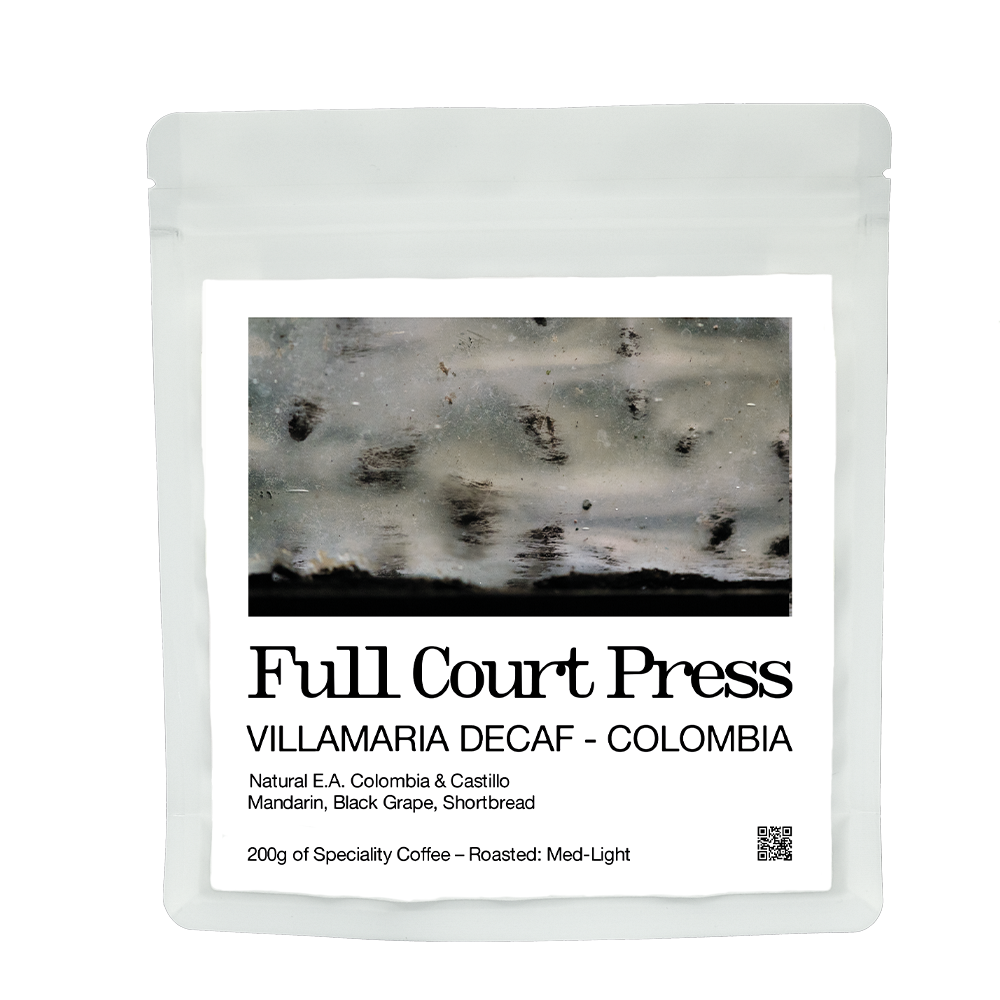
A Colombian natural EA decaf omni roast with mandarin, black grape, and shortbread notes.

A decaf from Mexico made with Bourbon, Typica and Penazco grown between 1,000 and 2,050 masl. Sweet, smooth and easy-drinking, it is designed to keep plenty of flavour in the cup without the caffeine.

A half-caff blend combining Swiss Water decaf from La Tribu Grupo Mujeres in Mexico with La Morena from Guatemala. Chocolate, toffee and plum notes make it balanced, flavourful and gentler on caffeine.

A sugarcane decaf from Happy Capybara in Minas Gerais, Brazil. Dark chocolate, hazelnut and caramel notes keep it sweet and familiar while staying true to the coffee's original character.

A chemical-free decaf currently sourced from Peru and processed using the Mountain Water method. It is selected for a smooth, sweet cup rather than the flat profile decaf can sometimes bring.

A washed EA decaf from smallholder producers in Huila, Colombia, using Castillo, Caturra, and Colombia varieties. Honey, cherry, and toffee notes give it a rounded espresso profile with plenty of sweetness.

Producer ASOPEP & ASCISP cooperatives, around 175 smallholder growers Farm/Mill El Indio Program, multiple indigenous family farms Location Planadas, Tolima Altitude 1,500 - 2,150 masl Process EF2 Natural, EA Decaf Cultivar Caturra Harvest 2026 Expect notes of Blackberry Jam, Treacle, Cacao El Indio is grown by smallholder families in Planadas, high in the mountains of Tolima. The coffee comes from two cooperatives, ASOPEP and ASCISP, together representing around 175 growers, some of them from the local Nasa We'sx indigenous community. Cherries are hand-picked and given Cofinet's EF2 extended fermentation, 24 hours aerobic then 50 hours sealed and cool, before drying whole. Decaffeination is sugarcane EA, using ethyl acetate derived from cane. Blackberry jam, treacle and cacao, with none of the caffeine.

An anaerobic honey Excelsa from local communities in Nzara and Yambio County, South Sudan, naturally lower in caffeine with chamomile, chestnut, and honey notes.

Producer COCAFELOL Co-operative (300+ smallholders) Farm/Mill Multiple smallholder farms Location Ocotepeque, Honduras Altitude 1,200 - 1,900 masl Process Washed, Mountain Water Cultivar Bourbon, Typica Harvest 2026 Expect notes of Dark Chocolate, Toffee, Brazil Nut Organic Decaf is our go-to decaf, decaffeinated without chemicals so you keep the full flavour of the coffee and lose only the caffeine. We roast it medium-light to stay clean and sweet. This release comes from COCAFELOL, a cooperative of around 300 smallholder farmers in Ocotepeque, in the mountains of western Honduras where the country meets Guatemala and El Salvador, grown between 1,200 and 1,900 metres and certified Organic and Fairtrade. A rich, nutty cup: dark chocolate, toffee and a long Brazil nut finish. The Fairtrade premium paid on COCAFELOL's coffee has built something practical: a small business that turns coffee husks and natural fungi into fertiliser, given to member farms free of charge. Decaffeination happens at Descamex in Veracruz, Mexico, where the green coffee is soaked in water from the glaciers of Pico de Orizaba, Mexico's highest mountain. The water draws out the caffeine along with the flavour, then is filtered to remove the caffeine and returned to the beans, so they take back everything that makes them taste of Honduras. Enough body for a flat white, enough sweetness to drink black after dinner.

A CO2 decaf from Brazil Montanari, sweet and balanced with praline cream, brown sugar, and orange.

A Colombian sugarcane-process decaf from a women producers group in Caldas. Apple, chocolate, and caramel notes keep the cup balanced, sweet, and approachable.

A darker-roasted blend built around a big chocolate profile and plenty of body. It is especially satisfying as espresso or cafetiere, landing rich, smooth, and straightforward.

Christmas Blend is back! One of our favourite coffees to craft each year and this year's line-up is tasting particularly festive. We've brought together three coffees from Kenya, Mexico and Costa Rica to create a rich, sweet and warming cup. Think mince pies, minus the crumbs. Basically, Christmas in a cup.

A sugarcane decaf from Colombia that keeps the sweetness and character of El Carmen intact. Chocolate, vanilla, and red fruit notes give it a full-flavoured cup without the caffeine.

A sweet, balanced espresso blend with the weight and structure to stand up well in milk. Expect toffee, dark chocolate, and a warming spice finish.

A blend made for sweet, milk-based espresso with a pronounced fudge character. It brings a creamy, lingering finish that works especially well as a flat white or cappuccino.
These links switch to another browse view. The matching coffees for this page are shown above.